
 InfoSearched
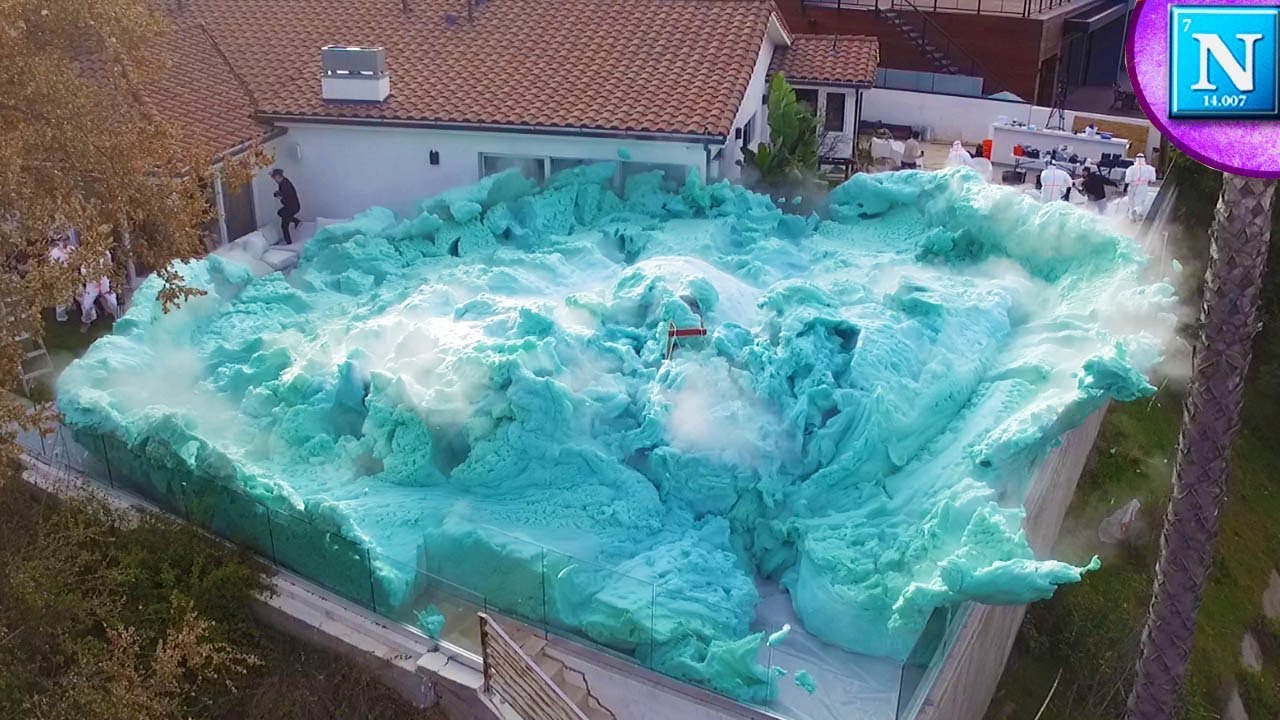
Nick Uhas turned David Dobrik’s backyard into a chemistry lab and buried it in blue foam.
Science YouTuber Nick Uhas and vlogger David Dobrik went back to the well in December 2019, staging a follow-up to their September elephant toothpaste stunt that was designed to dwarf the original. This time the reaction site was Dobrik’s Los Angeles backyard, with members of the Vlog Squad standing by as crew, camera operators, and — once the foam started climbing — the first ones sprinting for the fence.
- The team used 625 liters of 35% concentrated hydrogen peroxide, three times the volume from their September 2019 attempt.
- That figure is 245 liters more than the quantity Mark Rober and Science Bob used in their own record attempt, and roughly 15 times what Science Bob used in his 2018 benchmark version.
- The September attempt, calculated using an 8x8x3-meter pyramidal volume, had produced an estimated 67.5 cubic meters of foam — the number this new batch was built to blow past.
The Chemistry Behind the Blast
Elephant toothpaste is a classic catalytic decomposition demo: hydrogen peroxide breaks down into water and oxygen gas at a normally slow rate, but a catalyst speeds that reaction up dramatically. Uhas and Dobrik’s recipe combined Saf Instant yeast mixed with warm water, dish soap to trap the escaping oxygen as foam rather than letting it vent off invisibly, and saturated molar solutions of potassium iodide (KI) and sodium iodide (NaI) as the primary catalysts, with food coloring added for the visual punch.
Scaling that formula up to 625 liters of peroxide meant scaling every other component with it, turning what’s normally a tabletop science-fair trick into a stunt that needed an entire patio and pool area as its containment zone. The moment the catalyst hit the peroxide, the reaction didn’t build gradually — it erupted, sending a wall of dense blue-and-white foam rocketing upward before spreading out and swallowing the backyard.
625 liters of 35% hydrogen peroxide — three times their last attempt, 245 liters more than Mark Rober and Science Bob’s record, and roughly 15 times Science Bob’s 2018 version.
Chasing a Number They’d Already Broken Once
The September attempt wasn’t a one-off — it was the baseline. Uhas and his team had already run the pyramidal-volume math on that batch, landing on roughly 67.5 cubic meters of foam by cross-checking their per-liter output against the rough shape the foam blob had formed. Tripling the peroxide load for the December run wasn’t just about topping their own mark; it was about clearing Mark Rober and Science Bob’s previous record by a wide enough margin that there’d be no argument about who held the title.
Viral science stunts like this one live and die on exactly that kind of side-by-side comparison — whoever posts the bigger number, with receipts, gets to claim the record until somebody tops it. For a genre of video that lives alongside prank and reaction content elsewhere on YouTube, from remote-control gags to moments caught on camera that go viral for their sheer unpredictability, the appeal here was the same instant, visible payoff — just built on real stoichiometry instead of a jump scare.
The Backyard Couldn’t Hold It
Once the reaction kicked off, the foam didn’t stay politely inside a container. It surged high enough to tower over the group, then spread across Dobrik’s patio and pool, burying lounge furniture and deck space in a matter of seconds. Dobrik, Uhas, and the rest of the crew backed away and then ran outright as the blob kept expanding, which is exactly the kind of footage that made the clip take off across YouTube and TikTok almost immediately after it posted.
For anyone following the broader science-and-stunt corner of YouTube — the kind of channel that treats a backyard like a lab bench — the appeal isn’t just the mess. It’s the math behind the mess: real percentages, real liters, a real prior record to beat.
Uhas has made a habit of turning these numbers into content series, and the September-to-December jump — 67.5 cubic meters to a batch triple the peroxide volume — suggests the next attempt, whenever it comes, won’t be aiming for a modest bump. It’ll be aiming to make 625 liters look small.







Making and eating korean fire noodles
Hollywood Doppelgangers That Will Creep You Out
Dashcam footage of cash van crew under attack from CIT robbers
Eddie Griffin Knows How To Cure Racism
STORM DRAIN SURFING