
 InfoSearched
Tampa’s police chief thought he was announcing an arrest that would finally let a terrified neighborhood breathe. Instead, he set off a different scandal entirely.
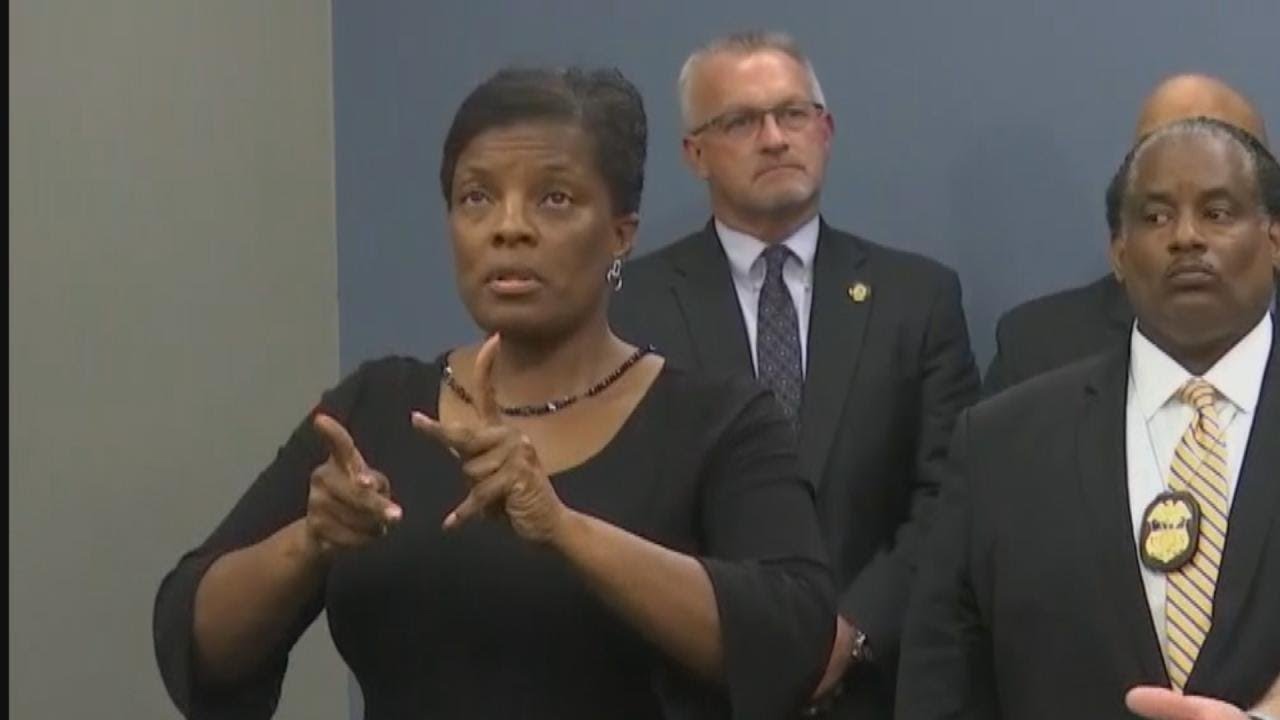
On November 28, 2017, Tampa Police Chief Brian Dugan stood before television cameras to announce the arrest of 24-year-old Howell Donaldson III in connection with the Seminole Heights serial killings. Standing beside him was a woman brought in to sign the briefing for deaf viewers, including the deaf mother of victim Monica Hoffa. Within minutes, ASL speakers watching the feed realized she wasn’t interpreting anything at all — she was making it up.
- The woman, identified as 53-year-old Derlyn Roberts, gestured through the chief’s remarks without translating a single coherent sentence, according to ASL teacher Rachell Settambrino.
- Tampa police spokesperson Steve Hegarty publicly took the blame, admitting, “I let her in. I didn’t ask enough questions.”
- Public records showed Roberts had prior felony convictions for fraud and grand theft, yet she faced no criminal charges because Florida law doesn’t actually require interpreters to be certified.
An Arrest Announcement Turns Into Something Else
The press conference itself was supposed to be the story. Donaldson’s arrest closed out weeks of fear in Seminole Heights, where a string of killings had left residents afraid to walk their own streets after dark. Chief Dugan laid out the details of the case for reporters and cameras, with a woman positioned at his side to relay the information to deaf viewers watching at home — a standard accommodation for a briefing of this magnitude.
Instead of clarity, the deaf community got confusion. Roberts stood through the entire briefing waving her arms and flashing signs that had no relationship to what Dugan was actually saying, leaving anyone relying on her translation with no real information about the arrest at all.
Gibberish Instead of ASL
Rachell Settambrino, an American Sign Language instructor at the University of South Florida, reviewed the footage and didn’t mince words about what she saw. She said Roberts waved her arms “like she was singing Jingle Bells” while stringing together signs that amounted to nonsense.
“Fifty-one hours ago, zero 12 22 murder three minutes in 14 weeks ago… 55,000 plea 10 arrest murder bush.”
That fragmented word salad, as translated back by Settambrino, is what deaf viewers were left with instead of an actual account of Donaldson’s arrest. For a community that depends entirely on interpreters to access breaking news in real time, it meant walking away from a major public safety announcement with essentially nothing.
Securing Her Place at the Table
The bigger question wasn’t just what Roberts signed — it was how she ended up standing next to the police chief in the first place. Hegarty explained that Roberts showed up uninvited, claiming to be the interpreter, and that he assumed someone else within the department had already arranged for contracted translation services.
He didn’t dodge the failure. “I allowed her to do it,” Hegarty said. “I didn’t ask enough questions.” It was a rare, direct admission from a department spokesperson that the vetting simply didn’t happen — no credential check, no confirmation with the deaf community’s usual service providers, nothing.
No Law Broken, No Charges Filed
Once Roberts’s identity surfaced, so did her record: state prison time and multiple felony convictions, including fraud, fraudulent use of personal information, and grand theft. Given that history, the obvious assumption was that she’d face charges for impersonating an interpreter at an official police briefing.
She didn’t. Hegarty confirmed that while her conduct badly misled the hearing-impaired public and violated basic ethical standards, it broke no Florida statute. State law requires interpreters to be “qualified,” but stops short of mandating certification through the national Registry of Interpreters for the Deaf — a gap that let Roberts walk onto a national stage with zero credentials and zero consequences. Roberts never responded to police calls asking how she learned about the briefing or why she showed up.
That’s where the story sits: no charges, no explanation from Roberts, and a police department now stuck explaining to the deaf community why nobody checked her credentials before handing her the microphone’s visual equivalent in front of national cameras.










Don’t Eat Another Costco Rotisserie Chicken Until You Watch This
Famous Kids Who Ruined Their Careers
The shortest game of Magnus Carlsen’s chess career!
The Joe Exotic Photos That Landed Miranda Lambert In Hot Water
Billionaires Do This For 10 Minutes Every Morning