
 InfoSearched
A teenager’s evening stroll through his grandfather’s field in central Turkey nearly became a fatal plunge into a 200-foot pit by morning.
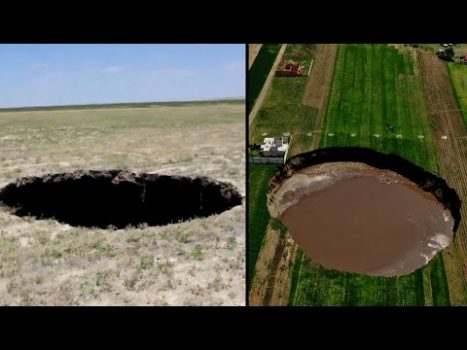
Inside Edition’s report on the incident, out of Turkey’s Konya province, captures exactly how fast the ground can turn on you in that part of the country. A 17-year-old boy walked across the same patch of his grandfather’s land the night before without seeing so much as a crack or a dip. By the next morning, a massive sinkhole had opened where he’d been standing hours earlier, and he says he nearly stepped straight into it.
- A 17-year-old discovered a sinkhole that opened overnight in his grandfather’s field in Konya province, Turkey, and says he nearly fell in while walking the property.
- The sinkhole measured about 9 feet across at the surface but dropped more than 200 feet straight down.
- The collapse fits a broader pattern of sinkholes, known locally as “obruks,” appearing with increasing frequency across the Konya plain.
An Overnight Collapse
According to the teenager’s account, there was no warning sign the previous evening — no sagging ground, no cracks, nothing to suggest the earth beneath him was hollow. Sinkholes like this one don’t creep open gradually; the surface holds until it doesn’t, and when the limestone cavity underneath finally gives way, the collapse happens in hours, not weeks. That’s what makes them so dangerous for anyone walking farmland in the region: the ground that was solid at sunset can be a vertical shaft by sunrise.
The Numbers Behind the Danger
The measurements alone explain why this was treated as a near-miss rather than just an odd discovery. The opening itself was roughly 9 feet wide, small enough that a person could easily misjudge it in low light or while distracted, but it plunged more than 200 feet down. A fall from that opening wouldn’t have been a scare — it would have been unsurvivable.
Nine feet wide at the top, more than 200 feet straight down — small enough to miss, deep enough to kill.
Konya’s Obruk Problem
Inside Edition framed this as part of a pattern rather than an isolated freak event. The Konya plain has seen a growing number of these collapses in recent years, enough that locals have a specific word for them: obruks. Farmers working fields across the region have increasingly had to reckon with the possibility that solid ground one day can become a hazard the next.
Primary Causes of Market Collapses
Geologists and local experts point to two compounding factors: prolonged drought and heavy groundwater pumping for agricultural irrigation. As water tables drop, the underground limestone cavities that once had support from saturated ground lose that stability, and the rock above them eventually caves in, leaving behind a near-perfect vertical pit. It’s the same basic mechanism behind other dramatic ground failures around the world, the kind cataloged in rundowns of the planet’s most dangerous natural phenomena — except here it’s playing out repeatedly across one specific stretch of farmland.
For families working land on the Konya plain, the teenager’s close call is now a cautionary story passed around as a reminder to watch where you step — even on ground you crossed safely the day before. With drought conditions persisting and irrigation demand not easing up, geologists monitoring the region expect more obruks to surface, not fewer.










Film Theory: Did Flash SPOIL Spiderman’s Next Villain?
Unexplainable Bruce Lee Moments that Defy Logic
Johnny Scoville’s Tube Of Terror Challenge (13 Million Scoville Peanuts)
Gravity Box Prank
Taylor Swift – The Man (Live From Paris)