
 InfoSearched
Long before bouillon cubes sat in every pantry, cooks were boiling down bones until soup turned into something you could carry in your pocket.
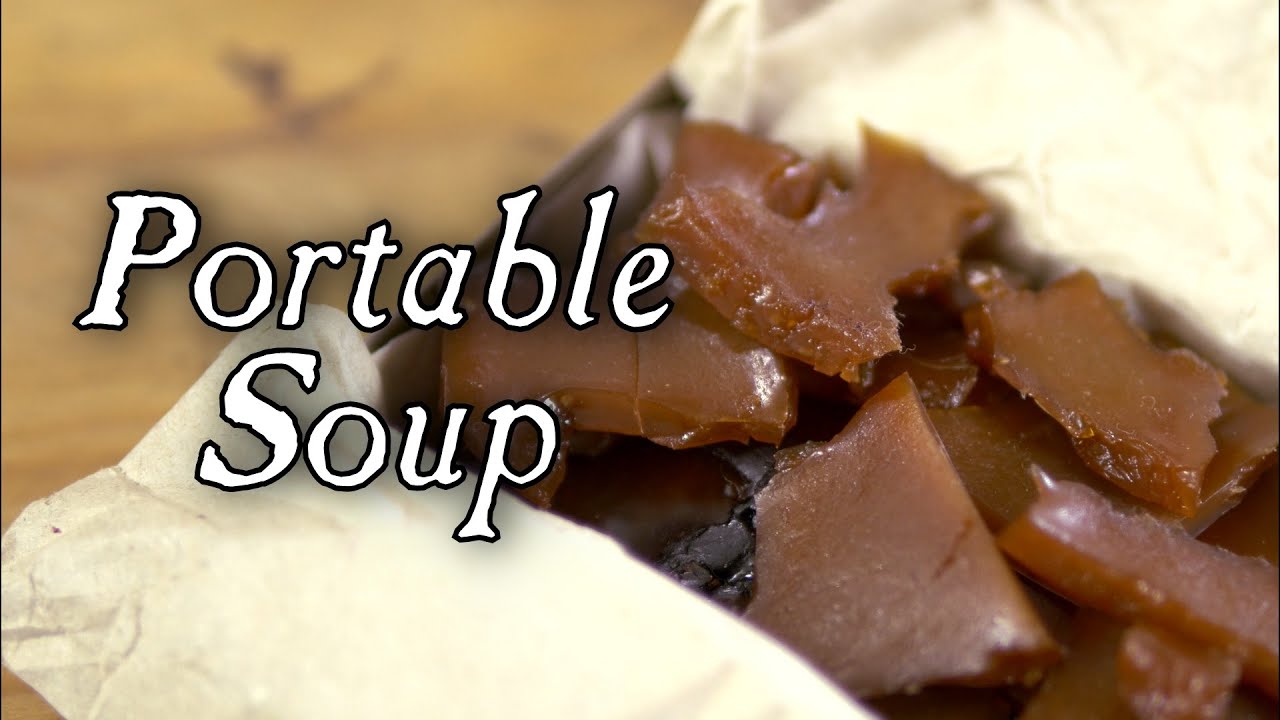
On April 27, 2015, the living-history channel Townsends published “Easiest Way to Make Portable Soup,” a demonstration of the 18th-century method for turning ordinary beef stock into a hard, shelf-stable cake that travelers could drop into boiling water and drink weeks or months later. The video strips away the fussier multi-meat recipes found in old cookbooks and shows how a single collagen-rich cut of beef can produce the same result with far less labor.
- The technique dates to at least the late 16th century, documented by Sir Hugh Plat, and was later refined in 18th-century cookbooks and carried on real expeditions, including Lewis and Clark’s 1805 Corps of Discovery crossing of the Bitterroot Mountains.
- Townsends’ simplified version relies on collagen-heavy cuts like beef shank or leg bones, simmered down to extract gelatin rather than combining several meats as older recipes required.
- The finished product — sometimes called “veal glue” — is a dried, glass-like lozenge that reconstitutes into broth with nothing more than boiling water, making it a direct ancestor of the modern bouillon cube.
The Method Behind Pocket Soup
The process starts with a long simmer of shank or leg bones until the connective tissue breaks down and releases gelatin into the liquid. That gelatin is what allows the finished broth to set firm once it cools — without it, there’s nothing to dry into a solid cake. Once the stock has fully extracted, it’s strained and skimmed of every trace of fat, a step Townsends stresses repeatedly, since any residual fat left in the mixture is what causes the dried soup to spoil during storage.
From there, the stock is reduced on low heat until it becomes a thick, syrupy glaze — far more concentrated than a normal broth. That reduction is what separates portable soup from a jar of homemade stock in the fridge; boiling off the water content is the only thing that makes long-term storage possible without any refrigeration at all.
From Liquid Glaze to a Dried Cake
Once reduced, the gelatinous liquid is poured out and left to cool into a stiff jelly, similar in texture to a firm gummy candy. That jelly gets cut into lozenges or slabs, then dried — traditionally spread on clean cloths in a dry, ventilated space — until each piece hardens into a leathery, almost glass-like sheet.
Skim the fat completely, or the soup won’t keep — that single step is what turns a pot of stock into something that survives a march across the Bitterroots.
The dried result can be stored in tin canisters, wrapped in paper, or kept in cloth for months without spoiling, since removing both the water and the fat eliminates the two things that would otherwise let bacteria take hold. Anyone reconstructing meals on a budget or experimenting with old techniques can find plenty of comparable hands-on demonstrations in the Cooking & Food Experiences archive, where knife work and reduction methods get the same close attention Townsends gives portable soup.
Armies and Explorers Relied Upon It
Portable soup earned its place in military and expedition kits precisely because it solved a logistics problem: protein that didn’t need refrigeration, didn’t spoil on a long march, and weighed almost nothing compared to fresh meat. Lewis and Clark carried it across the Bitterroot Mountains in 1805 as an emergency ration when game was scarce, and 18th-century naval and army cooks used it the same way — a few lozenges dissolved in a kettle of hot water produced an instant, protein-dense broth far from any hearth or butcher.
That same logic is why the dish reads as a direct forerunner of the bouillon cube sitting in a modern grocery aisle — the concept of condensing meat stock into a dry, storable form never really went away, it just got industrialized. Viewers who enjoy watching precise, methodical kitchen technique broken down step by step tend to gravitate toward similar breakdowns, like the Gordon Ramsay fish and chips demonstration, where speed and technique matter just as much as the ingredients.
Townsends built its channel on exactly this kind of recreation — pulling a forgotten technique out of period cookbooks and showing modern viewers it still works with a stockpot, a strainer, and patience. No fridge, no additives, no bouillon packet from the store — just bone, water, and enough drying time to turn broth into something you could carry in a coat pocket for a season.









The Black Hole technique – Acrylic fluid art painting
Khloé Kardashian & Kendall Jenner Can’t Believe Kris’ Sex Life
Why Hollywood Rejects Mana Massoud After Alladin
What Will Happen if You Eat 2 Bananas a Day
10 PLASTIC BOTTLE TRICKS YOU WILL BE SURPRISED