
 InfoSearched
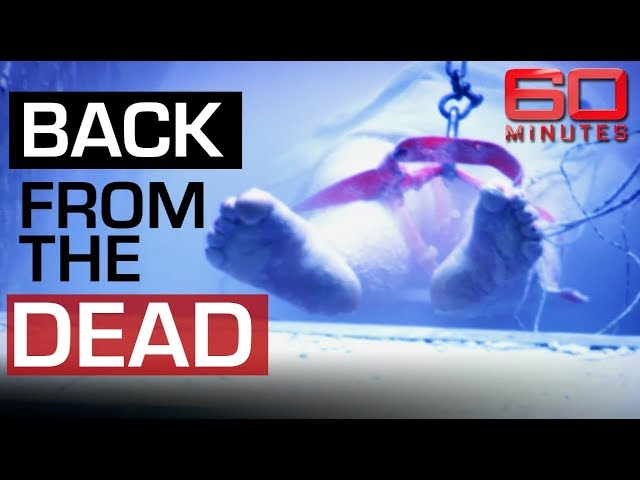
A 60 Minutes Australia crew was allowed inside a process almost no camera has ever documented: a woman’s body being frozen the moment after she was declared legally dead.
The report, “Frozen humans brought back to life,” follows Anita Riskin, an elderly woman who spent years arranging to have her body cryonically preserved the instant doctors pronounced her dead. Her son stands by her decision even as he wrestles with what it means, and cameras are there for the entire sequence — stabilization, cooling, and the pumping of cryoprotectant through her vascular system before she’s lowered into a liquid nitrogen storage tank at -196°C. It’s graphic, clinical, and unlike anything most viewers have seen of the cryonics process.
- Anita Riskin chose cryonic preservation upon legal death, with her son supporting the decision despite his own doubts.
- The procedure includes rapid cooling and cryoprotectant perfusion — flushing “antifreeze” solutions through the body to displace blood and water and stop ice crystals from forming — before vitrification and storage at -196°C in liquid nitrogen dewars.
- 60 Minutes sets that process against mainstream scientists and medical ethicists who call future reanimation unproven pseudoscience.
Inside Anita Riskin’s Decision
Riskin’s case is the spine of the report because it’s happening in real time, not recounted after the fact. She had already made her arrangements with a cryonics organization — the kind of outfit modeled on operations like the Alcor Life Extension Foundation — so that the moment she was pronounced dead, a standby team could move fast. Speed matters enormously in this field: cryonics advocates argue that the sooner cooling and perfusion begin after legal death, the less cellular damage accumulates before the body reaches a stable, ice-free state.
Her son’s role gives the segment its emotional center. He doesn’t pretend to be free of skepticism, but he backs his mother’s wish anyway, and that tension — love versus doubt — is what 60 Minutes leans on to keep the science segment from feeling like a lecture.
Physical Changes During Body Processes
The footage strips away the myth that cryonics is simply “freezing” someone like a steak. What the cameras show is a multi-stage medical procedure: stabilizing the body immediately after death, initiating rapid cooling, and then perfusing medical-grade cryoprotectant solutions through the vascular system to replace blood and water. That swap is the whole point — water left in the tissue would form ice crystals and shred cells at the microscopic level, so the cryoprotectant is designed to let the tissue vitrify, turning glassy rather than icy, before Riskin is submerged in a liquid nitrogen dewar.
At -196°C, liquid nitrogen halts every biochemical process in the body — the whole bet is that death, at that point, becomes a technical problem instead of a certainty.
That distinction — legal death as a possibly reversible state rather than a hard stop — is the philosophical hinge the entire cryonics movement rests on. It’s a claim readers can dig into further through outlets covering the underlying science and technology behind cryoprotection and vitrification research.
Faith Versus Mainstream Medicine
60 Minutes doesn’t let the cryonics side have the floor uncontested. Mainstream scientists and medical ethicists interviewed for the report are blunt: there is no established science showing a vitrified human body can be revived, repaired at the cellular level, and restored to consciousness. To them, the promise of future reanimation sits closer to speculative belief than tested medicine, and they say so on camera.
Riskin and her family, along with the cryonics advocates supporting her, see it differently. Their argument is that clinical death is a continuum rather than an instant cutoff, and that a body preserved without further decay today could, decades from now, be repaired by technology nobody currently possesses. It’s a wager on future science rather than a claim about present science — and the report is careful to let both sides state their case rather than settling it for the viewer. Anyone following the broader debate around aging, preservation, and the limits of resuscitation research can find more grounding coverage under health news.
The Legal and Technical Hurdles
Even setting aside whether reanimation is ever possible, the report makes clear how complicated the logistics are. A cryonics organization needs a standby team ready to move within minutes of a legal death declaration, specialized perfusion equipment, and long-term storage in dewars that must be topped up with liquid nitrogen indefinitely — potentially for centuries, if the wait for restorative technology is that long. Every one of those steps carries legal paperwork, family consent, and a financial commitment that has to be sustained far longer than any normal end-of-life arrangement.
Riskin’s family made peace with all of it before her death, which is exactly why 60 Minutes was able to film the process instead of reconstructing it. Whether the science ever catches up to the hope her son is holding onto is the one question the cameras can’t answer — that part of the story is still frozen, quite literally, waiting on a future none of us have reached yet.





This Ultra Modern Tiny House Will Blow Your Mind
Replay – Castlevania: Lament Of Innocence
The Raiders release Antonio Brown | SportsCenter
GUESS THAT SHREK REFERENCE CHALLENGE (React)
World First – Skydiver Luke Aikins Jumps 25000 Feet Into Net With No Parachute