
 InfoSearched
A single cleaver turns a raw potato into something that looks impossible to eat and even harder to believe.
The clip runs three minutes and twenty-five seconds, set to traditional Chinese folk music, and by the end of it a whole potato has been transformed into threads fine enough to pass through the eye of a needle. Published by the culinary channel Taste Show, “Satisfying Knife Skills – Cut Potato | Chinese Recipes by Masterchef” puts chef John Zhang’s blade work front and center, then uses that prep work to build an actual dish rather than just show off. It’s become one of Taste Show’s biggest hits, pulling in tens of millions of views.
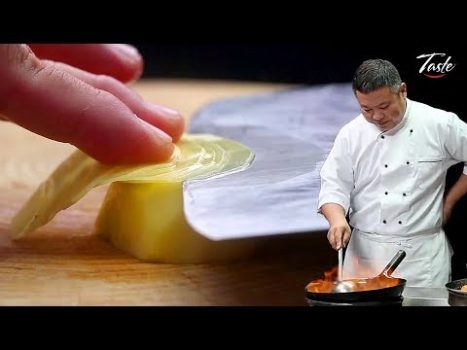
- Chef John Zhang, trained in Shanghai and a gold medalist in Huaiyang cuisine at the 2009 International Chinese Culinary Competition, slices a whole potato into wafer-thin, translucent sheets described as resembling cicada wings, then cuts them into hair-fine threads.
- He turns the shredded potato into a finished recipe, “Ultra-Crispy Potato Crust Scallops,” combining scallops and shrimp into seafood balls that get rolled in the deep-fried potato threads.
- The video has amassed tens of millions of views, making it one of Taste Show’s most-watched uploads.
The Cleaver Doing All the Work
Zhang works exclusively with the single Chinese cleaver that traditional cuisine relies on for everything — slicing, shredding, shaping, even the flat side for crushing. There’s no mandoline, no julienne peeler, no gadget doing the heavy lifting. He starts by breaking the potato down into sheets so thin they’re see-through, the kind of cut Chinese kitchens compare to cicada wings for how much light passes through them. From there he stacks and shreds those sheets into threads that are, by the video’s own demonstration, thin enough to thread a needle.
That kind of precision is the whole point of the video, and it’s why it plays so well outside of cooking circles — you don’t need to know Huaiyang cuisine to see that the cuts are absurdly clean and absurdly fast. It’s the same instinct that makes viewers stop scrolling for cookie shaping hacks or a chef ripping through a recipe against the clock.
From Garnish to Main Event
Most knife-skills videos stop at the cut. Zhang keeps going. The potato threads aren’t a garnish here — they become the crust. He blends fresh scallops and shrimp into seafood balls, cooks them through, then deep-fries the potato shreds separately until they turn golden and crisp. The seafood balls get coated in a savory salad dressing and rolled directly across the fried threads, so the shreds stick and wrap the surface in a texture that looks almost like a woven basket.
Sliced thin enough to resemble cicada wings, then cut fine enough to thread a needle — before any of it hits the fryer.
The result is “Ultra-Crispy Potato Crust Scallops,” a dish built entirely around a knife cut most home cooks would never attempt. It’s a reminder that in Chinese kitchen tradition, the cutting board isn’t prep work separate from the cooking — it’s part of the recipe itself, the same way a chef reworking a familiar dish, like fish and chips made fast at home, treats technique as the actual selling point.
A Chef With the Credentials to Back It Up
Zhang isn’t a social-media knife trickster; he trained in Shanghai and carries a gold medal in Huaiyang cuisine from the 2009 International Chinese Culinary Competition, one of the discipline’s more demanding regional styles, prized for exactly this kind of fine, exacting cutwork. That background is what separates the video from a novelty clip — the technique on display is a real, judged culinary skill, just condensed into something shareable.
Factors Driving Long Distance Travel
Taste Show has built an audience on this exact format: minimal talking, traditional music, a knife doing something viewers didn’t know was possible. This particular upload leaned into two hooks at once — the “how is that even possible” cut and the “wait, he’s actually cooking something with it” payoff — which is likely why it outperformed even the channel’s usual numbers, landing in the tens of millions of views.
Zhang never explains the technique in words in the video — the cleaver does the talking, sheet by sheet, thread by thread, until a potato that started as one whole vegetable ends up as the crust on a plate of scallops.







The Future of Medicine
THE BEST UPCOMING MOVIES 2020 (New Trailers)
Venom 2’s Official Title Has Marvel Fans Scratching Their Heads
Brexit: UK’s new PM accused of pursuing ‘no-deal’ – BBC News
Visiting Capcom for Monster Hunter World: Iceborne