
 InfoSearched
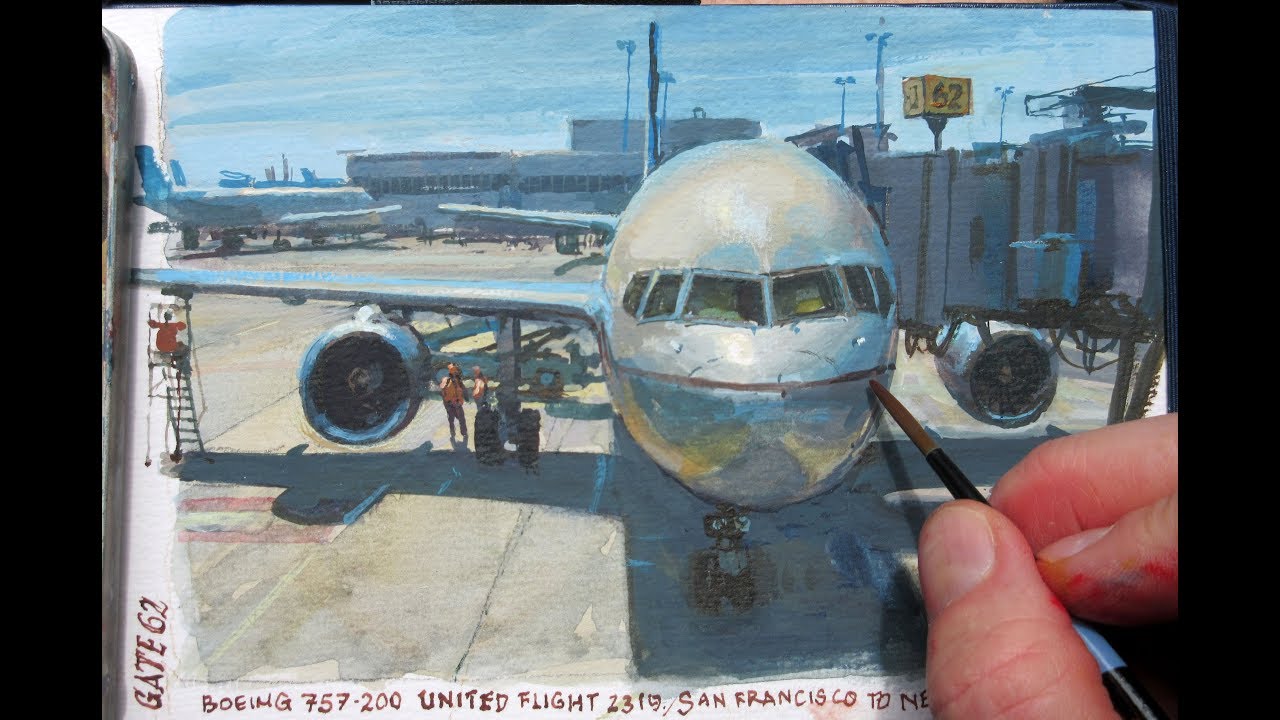
An artist races the boarding call, brush in hand, at a gate inside SFO.
James Gurney has built a career sketching dinosaurs and lost civilizations for the Dinotopia books, but his latest video finds him staring down a much more mundane deadline: a one-hour boarding window at San Francisco International Airport. Instead of scrolling his phone at the gate, Gurney pulled out a compact sketchbook and a set of gouache paints and went to work on the parked airliner sitting just beyond the terminal glass. The result is “Painting an Airliner in Gouache—an hour before boarding,” a real-time demonstration of plein-air painting under travel-day pressure.
- Gurney painted a live study of a commercial airliner parked on the tarmac at SFO, working through the terminal windows with roughly an hour before his flight boarded.
- He used gouache, an opaque water-based medium prized for drying fast enough to let an artist layer color quickly without waiting between passes.
- Viewers online noted the terminal composition resembled the “Terminal” map from Call of Duty: Modern Warfare 2, a comparison Gurney addressed directly in the video’s description.
Gouache Benefits for Tight Deadlines
Watercolor rewards patience — thin washes need time to settle and dry before the next layer goes on. Gouache skips that wait. Because the pigment is bound with more opaque, chalky density, Gurney can lay down a dark value, let it dry in a minute or two, and paint a lighter, opaque highlight directly on top without the colors bleeding into mud. That’s the entire logic behind his “Gouache in the Wild” approach: it’s the medium built for artists who don’t get the luxury of a studio schedule.
An airliner on a jet bridge is a brutal subject for a rushed sketch. The fuselage curves in ways that punish sloppy perspective, the engine cowlings and landing gear introduce hard geometric shapes, and reflected light bouncing off the tarmac and the aircraft’s aluminum skin shifts the values constantly. Gurney treats all of it as a values problem first — blocking in the big dark-to-light relationships before chasing any fine panel lines or window details, which is exactly the triage a one-hour countdown demands.
Reading the Terminal Like a Painter
What makes the piece work isn’t just the airplane — it’s the framing. Shooting through the terminal glass, Gurney gets a foreground of window mullions and gate furniture, a middle ground of tarmac equipment, and the airliner itself receding at an angle that forces real foreshortening on the nose and wing. That’s the same kind of layered, receding-plane composition he teaches in his instructional material on light and color, just compressed into sixty minutes instead of a studio afternoon.
It’s also, apparently, a composition gamers recognized instantly.
Gurney addressed the resemblance to the “Terminal” map from Call of Duty: Modern Warfare 2 directly in his video description, noting it was simply a live study done at San Francisco airport.
A Working Artist’s Habit
This isn’t a one-off stunt. Gurney has spent years documenting spontaneous sketching sessions — watercolor, casein, gouache — wherever travel puts him, turning airport terminals, hotel lobbies, and roadside stops into makeshift studios. The airliner sketch is consistent with that body of work: a working painter treating dead travel time as studio time, and sharing the process rather than just the finished page.
Gurney never says whether he finished the painting before his group was called to board, and that’s sort of the point — the video ends the way most airport sketches do, mid-brushstroke, with the gate agent’s announcement doing the editing for him.





Arizona man, 110 years-old, credits long life and health to 5 foods
CM Punk makes his surprise debut on WWE Backstage | WWE BACKSTAGE | WWE ON FOX
THIS is How You Know Carole Did it – Tiger King Update New Episode – Joe Exotic
STANDING ONLY Korean BBQ & CHEAP All You Can Eat STEAK in Seoul
INHERITANCE Trailer (2020) Lily Collins, Simon Pegg Thriller Movie